
XIAOCHONG ENERGY · Buyer articles
Small EV Charging Sites in Ethiopia: Fit the Vehicles, Not Just the Cabinet
A compact yard, hotel parking area or urban fleet base in Ethiopia may appear to have room for a charger while still lacking room for a usable charging operation. The right question is not “Will the cabinet fit?” but “Can the intended vehicles connect, leave and be serviced without blocking people or one another?” Use this layout review before committing to equipment.
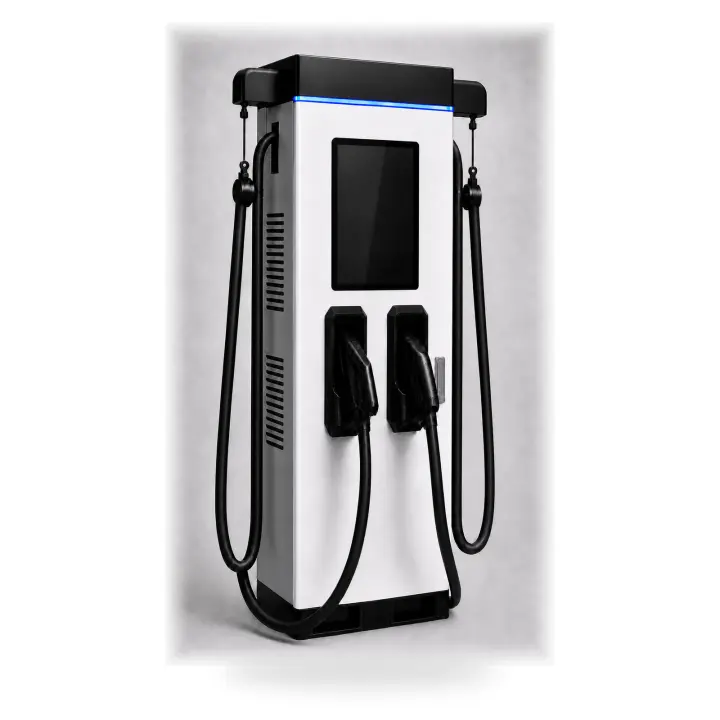
Draw the full operating envelope
Mark the equipment body, any separate dispenser or pedestal, door opening, ventilation and service access from the selected model’s installation drawing. Add the vehicle envelope, manoeuvring path, charger inlet location, pedestrian routes and any locally required protection or accessible space. Do not substitute a product photograph for a dimensioned drawing.
The U.S. DOE’s infrastructure planning guidance includes proximity to electricity, weather, expansion and maintenance in site evaluation. These are useful planning considerations, not Ethiopian installation rules. A qualified local project team must determine the applicable dimensions, permits and safety requirements. This guide intentionally does not invent a universal minimum clearance.
Test the cable path at the actual parking position
A cable does not travel along a perfect straight line between two dots. The route must account for the connector position, obstacles, supported slack and the way the vehicle is parked. Check each intended vehicle group rather than one demonstration car. A bay that works for a front inlet may not work for a rear-quarter inlet without repositioning the vehicle.
Xiaochong charging cables are generally 5 m as standard, with shorter or longer configurations available for review. A longer cable is not automatically the cheapest or safest way to fix a poor layout: model compatibility, handling and manufacturer-approved routing matter. Do not use an improvised extension or route a cable across a required pedestrian or escape route.
Separate bay count, connector count and charging capacity
Illustrative layout case: four parking bays share equipment with four charging outputs. This does not establish that all four vehicles receive the cabinet’s full nameplate power. The Xiaochong four-gun series lists 80/120/160/240 kW configurations; the selected system’s total power and output-allocation rules need written confirmation.
Check both the physical queue and the energy queue. Can an early-departure vehicle leave without another vehicle moving? Is the correct connector free when it arrives? If one output is unavailable, which departures are affected? These questions often reveal a more useful investment than simply adding another parking bay to a drawing.
Compare the compact options without assuming savings
New ultra-slim dual-gun DC configurations in the 60–240 kW range are candidates when the installation envelope and operating pattern fit. Wall-mounted DC or AC destination charging may be relevant to other dwell times and vehicle needs. “Ultra-slim” describes the product approach; it does not provide a verified dimension or waive ventilation and service space.
- Request exact drawings for each shortlisted model and include all separate equipment.
- Compare cable routing, civil works, service access and foreseeable expansion on the same plan.
- Confirm the site’s usable power and vehicle charging window independently of the layout.
- Ask for documented ambient conditions and any temperature or altitude limitations relevant to the actual site.
- Keep the selected vehicle list and connector configuration attached to the quotation.
Run a practical acceptance review before scaling
Agree who owns installation inspection, vehicle compatibility checks, backend setup and staff training. Have the responsible project team demonstrate normal parking, connection, charging completion and departure using the intended vehicle types. Establish how an operator records the charger ID, connector, session time and exact fault message when escalation is needed.
The site-layout tool below helps assemble a procurement checklist; ticking its boxes does not approve construction. Send the completed brief, photographs without personal information and a dimensioned plan to Xiaochong for product discussion. We are a supplier based in China, not a claimed Ethiopian branch or local installer. Final engineering, permissions and service arrangements must be agreed for your project.
Will a 5 m cable reach? A worked planning example
Use the cable length and layout checker to compare parking positions before requesting a custom cable. Measure from the selected cable exit to the intended vehicle inlet, using metres. Test the least convenient inlet location in your expected fleet.
Illustrative inputs: horizontal offset 3 m, charger setback 1 m, vertical difference 0.5 m, routing allowance 25%, handling slack 1 m and planned cable length 5 m. The tool calculates a straight-line distance of √(3² + 1² + 0.5²) = 3.20 m. With the chosen allowance and slack, the estimated requirement is 5.00 m when rounded to two decimals. Before rounding, it is about 5.002 m, so the tool correctly flags a small shortfall. A displayed 0.00 m shortfall is a rounding effect, not proof of reach.
For comparison, reducing only the horizontal offset to 2.5 m gives an estimated requirement of 4.42 m and approximately 0.58 m geometric margin. This is a hypothetical comparison, not permission to move installed equipment. An approved site plan must still preserve service access, traffic protection, pedestrian movement and accessible use.
The 25% allowance and 1 m slack are example assumptions, not standard design values. The calculation does not model obstacles, bend radius, cable weight, cooling, current rating or the usable extension of a cable-management mechanism. Check the exact drawing and a representative vehicle connection with the responsible installer before ordering. Never improvise an extension to resolve insufficient reach.
The UK Office for Zero Emission Vehicles recommends checking cable access across vehicle inlet locations and considering handling and trip hazards. Its chargepoint design considerations are a design reference, not Ethiopian installation rules. This example was rechecked on 15 September 2026.
Use a worst-case vehicle-inlet matrix before ordering
Do not validate reach with only the easiest demonstration vehicle. On a scaled drawing, test every expected inlet zone—front-left, front-right, rear-left and rear-right—against each permitted parking orientation. Record the cable exit point, wheel-stop position, straight-line distance, routing allowance, handling slack and the remaining geometric margin for every combination.
Any combination that fails should trigger a layout decision: change the assigned bay, reposition the charger on an approved plan, review an approved cable configuration, or exclude that vehicle-position combination. Never solve a failed case with an improvised extension. A passing geometry result still needs the selected model drawing and review of cable weight, cooling, bend radius, current rating, storage and local requirements.
The U.S. Access Board notes that vehicle inlet locations vary by make and model, that cables must not obstruct accessible routes when stored or connected, and that cable-management systems must remain maintained. These are U.S. accessibility recommendations, not automatic approval for another market. Apply the destination country's rules and the responsible local professional's design.
Buyer questions
Can an ultra-slim charger fit every narrow parking space?
No. Its complete installation and service envelope must fit together with vehicles, people, ventilation and cable routing.
Should we order a longer cable before redrawing the bay?
First test vehicle position and safe routing. Then request an approved cable configuration if still needed; do not improvise an extension.
Continue your project review
Sources and scope
- U.S. DOE AFDC: charging infrastructure planning and site considerations (not local installation approval)
- U.S. Access Board: accessible EV charging station design recommendations
- UK Office for Zero Emission Vehicles: chargepoint design considerations
Source review updated 15 September 2026. The procurement scenarios and examples are our analysis, not reported customer projects, engineering approval or local legal advice.
Discuss this project
xc0225888@163.com