DC FAST CHARGING · ENGLISH BUYER GUIDE
EV charger power sharing: ask for the simultaneous output matrix before ordering
By Xiaochong Energy · · 7 min read
A 240 kW cabinet with four connectors is not automatically four independent 240 kW outputs. The useful buying question is: what can this exact charger deliver when one, two, three or four vehicles are connected, and what evidence will prove it?
This is a procurement and acceptance-planning guide. It does not authorize energized testing or changes to charger, vehicle, protection or site limits. Testing must follow the approved model-specific procedure and be performed by authorized, qualified personnel using suitable equipment and safe test conditions.
Headline power and simultaneous power are different questions
Multi-connector stations can be designed in several ways. One cabinet rating may describe the station's total conversion capacity, while individual outputs share that capacity. A connector can also be limited by its cable, contactor, power path, configured current or voltage range. The vehicle adds another limit: it controls what it requests and may reduce demand because of battery temperature, state of charge or its own charging curve.
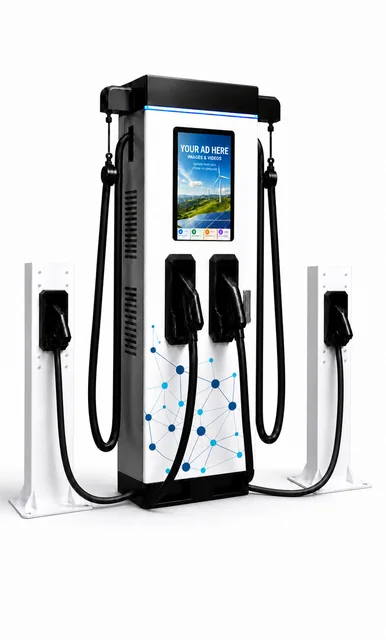
This is why a photograph, connector count or headline kW cannot establish simultaneous performance. A useful quotation identifies the station total, each output envelope, internal allocation logic and tested combinations. If the intended site needs four vehicles charging at once, the four-session case belongs in acceptance—not in an assumption.
First map connector, EVSE and transaction behaviour
The Open Charge Alliance's application note on multiple connectors per EVSE explains that connector and EVSE are not interchangeable concepts. Its discussion of two-tier and three-tier models is especially relevant when reviewing older OCPP 1.x implementations. Buyers should ask the supplier to draw the selected charger's actual logical and physical arrangement instead of guessing from the number of cables.
For every cable, record its connector identity, whether it has an independent power path, which combinations can run concurrently, and how transactions are represented to the management system. If two cable types are alternatives on one EVSE, they may not be usable simultaneously. If outputs are independent, the total cabinet limit may still require allocation across them.
The matrix to attach to the RFQ
| Test case | Buyer records | Evidence to retain |
|---|---|---|
| One active session | Output identity, requested and delivered voltage/current/power, vehicle or simulator limit, station input and steady-state period. | Timestamped charger and test-equipment data tied to model, serial number, firmware and configuration. |
| Two active sessions | Each output's demand and delivery, total output, allocation rule, priority setting and response when the second session starts. | Synchronized records showing both outputs and the station total before, during and after the transition. |
| Three active sessions | Same fields, plus any minimum block size, unavailable combination or order-dependent behaviour. | Approved test result for every combination required by the project—not only the easiest connector order. |
| Four active sessions | Per-output delivery, station total, site limit, thermal or time limits and behaviour if one vehicle reduces or stops demand. | Signed acceptance record for the ordered configuration, or a clearly stated “not supported” boundary. |
| Session transition | Start, stop, reconnect and demand-change events; reassignment delay; impact on continuing sessions; transaction identity. | Charger logs, CSMS records and electrical measurements aligned to a common clock. |
Do not require a supplier to promise a number the vehicles cannot request. Use a qualified EVSE test system or representative vehicles whose voltage, current and charging behaviour are documented. The matrix should distinguish a charger limit from a vehicle limit and a site limit.
Five allocation questions that change the business case
- Fixed split or dynamic allocation? A fixed split is predictable; dynamic allocation can move unused capacity to another session. Ask what policy is available on the ordered firmware and who may change it.
- What is the minimum useful allocation? A connected vehicle may pause, reject or operate inefficiently below a threshold. Ask how the system behaves when available power is below a configured or vehicle-accepted minimum.
- What wins during congestion? First connected, equal share, configured priority, departure target or another rule? The commercial operator should approve the policy before commissioning.
- How quickly is capacity reassigned? When one session ends or reduces demand, record the transition and whether the released capacity reaches other eligible sessions without disrupting them.
- Which limit has authority? The cabinet, each connector, the site controller, CSMS profile and vehicle may all impose limits. The acceptance plan must show how the complete chain behaves safely.
OCPP is part of the evidence, not a substitute for it
OCA describes OCPP 1.6 smart charging as supporting load balancing and charging profiles, while OCPP 2.x adds broader smart-charging functions. OCA's 2.0.1 certification page also lists Smart Charging as an optional certification profile, separate from the mandatory Core profile. See the OCPP protocol overview and OCPP 2.0.1 certification profile description.
Therefore, “supports OCPP” does not prove a particular power-sharing rule, profile support or tested CSMS combination. Record the exact OCPP version, charger firmware, supported smart-charging functions, management platform, offline fallback and local configuration. Then test the intended combination. If certification is claimed, verify the exact product and software version rather than relying on a generic logo.
Convert the matrix into throughput and site decisions
Per-vehicle peak power is only one planning variable. A fleet depot may value reliable simultaneous energy delivery during a fixed parking window. A public hub may value rapid reassignment as vehicles arrive and leave. A constrained site may intentionally cap the cabinet below its hardware maximum. For each operating case, calculate the energy that can be delivered during real dwell windows and compare it with vehicle demand.
Keep three totals separate: installed charger nameplate capacity, permitted site input and demonstrated simultaneous output under the acceptance case. This prevents a larger catalog number from being mistaken for more usable throughput. It also exposes whether extra connectors improve queueing and parking flexibility even when the cabinet's total power is shared.
Acceptance package for a multi-connector DC charger
- Approved single-line architecture showing cabinet, power modules, EVSEs, connectors, site controller and upstream limit.
- Model-specific voltage, current and power envelopes for each output, plus supported concurrent combinations.
- Completed one-to-four-session matrix where applicable, with demand and delivery recorded separately.
- Allocation policy, priority settings, minimum behaviour, reassignment logic and access-control responsibility.
- Charger, CSMS and test-equipment records aligned by timestamp and identified by version.
- Pass/fail criteria for steady operation, transitions, communication loss, recovery and any unsupported case.
- Named owner for configuration, future firmware changes and regression testing after material updates.
Close every blank cell before shipment or label it as not applicable with a reason. “To be confirmed on site” is not adequate for a condition that determines whether the purchased configuration can meet its service plan.
Buyer FAQ
Does a four-connector charger deliver nameplate power to every vehicle simultaneously?
Not necessarily. Confirm total station power, individual output limits, supported concurrent combinations and the model-specific allocation matrix.
Does OCPP support prove local power-sharing behaviour?
No. OCPP can provide control functions, but the result depends on the charger, firmware, configuration, CSMS, site limit and vehicles. Test the complete intended system.
What belongs in the simultaneous output matrix?
Include every required active-session count, connector identity, demand and delivery, station input, allocation rule, transitions, versions and signed evidence.
Request a model-specific output review
Xiaochong Energy Technology (Zhongshan) Co., Ltd., China, can discuss multi-connector DC charger configurations, site power, OCPP integration and project acceptance requirements. Xiaochong's four-connector portfolio includes multiple total station power options; exact per-output allocation, connector combination, voltage/current envelope and simultaneous performance must be confirmed for the selected model, firmware, vehicle mix and contract.
Send the destination country, vehicle models and connectors, daily sessions, dwell windows, available site power, required simultaneous-session count, CSMS and acceptance method. Review the four-connector product page, use the site power planning tool, or read the multi-output procurement guide.
xc0225888@163.com · Sales 1: +86 137 1772 6888 · Sales 2: +86 134 2580 6997
Related buyer guides
- When a four-connector DC charger makes sense
- Dynamic load balancing for commercial sites
- Factory and site acceptance evidence
Primary sources reviewed 12 September 2026. This is Xiaochong's original procurement guidance. It is not an Open Charge Alliance endorsement, a model specification or proof of certification. Final electrical, protocol, safety and destination-market requirements need project-specific review by qualified specialists.