SERVICE READINESS · ENGLISH BUYER GUIDE
EV charger spare parts: buy a service plan, not just a box of components
By Xiaochong Energy · · 6 min read
Before a fleet depot, charging operator or local distributor buys a batch of chargers, ask a second question beside the equipment price: if one unit needs a replacement part, who will identify it, obtain the approved revision and return the charger to service?
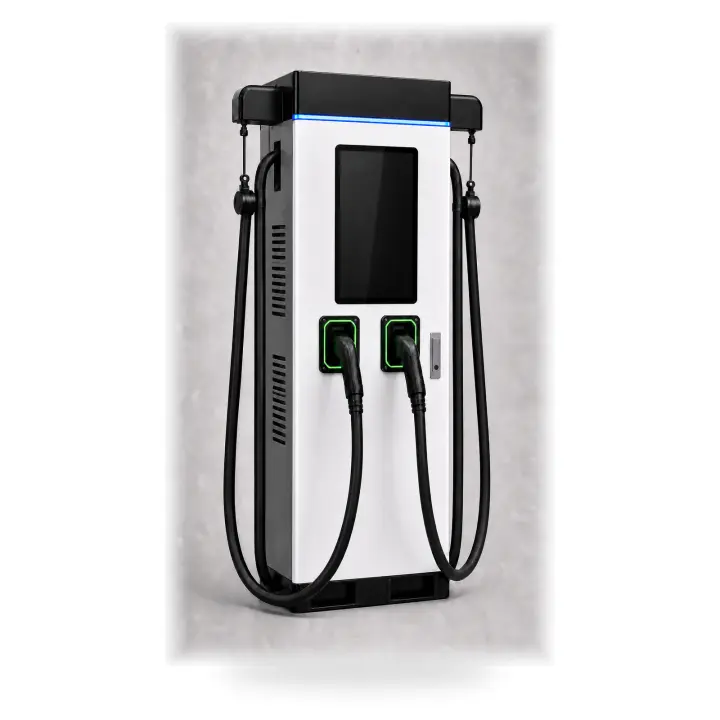
This guide helps buyers define procurement and service responsibilities. It is not a troubleshooting sequence or permission to open a charger. Electrical work, component replacement and return-to-service testing require qualified personnel, approved model-specific procedures and local compliance review. Never bypass protection or use a visually similar part without supplier approval.
1. Start with the installed configuration
A description such as “DC charger controller” is not enough for a reliable purchase order. Request a controlled equipment record for each model and configuration: charger model, serial number or serial range, bill-of-materials revision, approved firmware baseline and the supplier's spare-part references. If your chargers were delivered in several batches, ask whether the same replacement is approved across every batch.
For each proposed spare, require written confirmation of compatibility and any associated requirements. A replacement may need a matching harness, configuration work, software entitlement or an approved commissioning procedure; do not assume these are included. The useful deliverable is a revision-linked parts list, not merely a photograph or a list of component brands.
This is different from the fault-reporting checklist: incident evidence helps diagnose a problem, while the parts register helps procure the correct approved solution after diagnosis.
2. Separate stocked parts from service capability
A warehouse stock count does not tell you whether a technician can complete the work. Ask who can diagnose the fault, who may authorize a replacement, who performs the intervention and who signs off the result. Record the escalation contact and the hours covered in the actual agreement; do not read “technical support” as a promise of continuous on-site attendance.
As an industry example, Alpitronic describes replacement parts, technician training and a document system for manuals and service records as distinct elements of its own support offering. That illustrates why buyers should review these workstreams separately; it does not establish Xiaochong's service coverage or compatibility with Alpitronic equipment. Source: Alpitronic Hyperservices.
For your project, request the training syllabus, intended technician role, available language, delivery format and assessment method. A video can be useful reference material, but watching it does not by itself qualify someone to work on energized equipment or authorize a repair.
3. Build a three-level stock decision
Local stock
Consider an approved part locally when its absence would block an important operation and an authorized service team can use it. Confirm storage conditions, traceability and any shelf-life requirements before buying.
Shared regional stock
For several sites using compatible configurations, evaluate a shared pool. Record dispatch responsibility, transport time, stock ownership and how a replacement is replenished after use.
Supplier-held stock
Ask for the order-to-dispatch commitment, not just “available.” Separate approval, preparation, transport, import handling and local appointment time. Verify destination-specific arrangements in the quotation.
No speculative purchase
If the compatibility or failure evidence is unknown, obtain clarification first. Do not buy expensive assemblies solely because they appear in an unverified generic spare-kit list.
There is no universal percentage of chargers that should be bought again as spares. Set initial quantities using the ordered configuration, available service evidence, consequences of an unavailable outlet and replenishment uncertainty. Review the plan after your own pilot rather than presenting an assumed failure rate as a measured fact.
4. Compare full recovery cost, with assumptions visible
For each option, compare the stocked-part cost, storage and inventory administration, diagnosis, approved labour, transport, return handling, recommissioning and any separately charged software or support. Keep taxes and import assumptions explicit. A warranty replacement part does not automatically mean free labour, freight or on-site service; ask which costs the agreement covers.
Illustrative planning case, not customer data: an operator has six chargers of two different revisions. Instead of ordering two identical “universal” spare kits, the buyer requests a compatibility matrix for all six serial numbers, then compares separate local stock with a shared approved pool. Without the matrix, the apparent saving cannot be evaluated reliably.
If you model lost charging revenue, show the assumed sessions, energy sold and contribution margin separately. Traffic diverted to another outlet is not necessarily lost revenue. Do not turn a rough estimate into a guaranteed payback claim.
5. Put eight fields in the spare-parts schedule
- Equipment identity: model, serial range, hardware revision and agreed firmware baseline.
- Approved item: supplier part number, revision and written compatibility statement.
- Scope: included accessories, configuration tasks, instructions and separately priced items.
- Quantity basis: installed population, pilot evidence and the reason for the proposed stock level.
- Availability: stock location, preparation time and the party responsible for replenishment.
- Service authority: named responsible organizations, qualified roles and escalation route.
- Commercial boundary: warranty approval, labour, transport, returns and any core-return conditions.
- Closure evidence: approved return-to-service procedure, service record and responsible sign-off.
Use the free RFQ brief builder to structure the overall request, then add this schedule to your purchasing brief. The tool is a planning aid, not a parts-compatibility checker or electrical approval.
6. Link the pilot to a maintainable fleet
Before accepting repeat deliveries, review whether the pilot team can locate the correct documents, identify the approved part and explain the escalation route. Have the qualified team agree any demonstration and testing with the supplier in advance. Do not create faults, disconnect safety devices or swap parts merely to simulate a breakdown.
Carry the approved service-document list into the factory and site acceptance plan. After a legitimate service event, record the diagnosed issue, approved action, fitted revision, test outcome and remaining restrictions. Feed that evidence into the stock decision. Traceable learning is more useful than quietly increasing the inventory whenever a new problem appears.
Request separate AC and DC support packages
Xiaochong Energy Technology (Zhongshan) Co., Ltd., China, works with overseas buyers and businesses considering local charger assembly. For AC EV charger SKD kits and technical documentation, define the selected AC model, component list, assembly responsibilities and approved maintenance-document scope. For DC EV charger SKD kits and technical documentation, separately define the power/control component scope, integration responsibilities, qualified testing and service requirements.
Discuss the SKD supply scope and AC/DC procurement brief. Neither kit type is automatically a complete spare-parts package for every charger. A part shown in an illustration is not a compatibility promise.
Available AC or DC technical documentation is free on request. Production/assembly support, professional repair-skills support, training videos and multilingual drawings can be discussed for the exact model and project. Confirm document revisions, requested language, availability, training scope and licensing in writing. Hardware, all training, unrestricted intellectual property, certification and on-site labour are not automatically free. See our manufacturing and distribution partner program.
Send your country, company, AC/DC track, pilot or installed quantity, model references and local technical capability. Ask for an approved parts/document list and the service responsibility matrix. Do not include passwords or private customer records.
xc0225888@163.com · Sales 1: +86 137 1772 6888 · Sales 2: +86 134 2580 6997
Related operating checklists
Primary source reviewed 8 September 2026. This is Xiaochong's original purchasing worksheet, not a manufacturer repair manual, an endorsed partnership with the cited company or a certification claim. Final service and safety requirements need model-specific qualified review.